
What is Kyoto Ichihitsuryu?

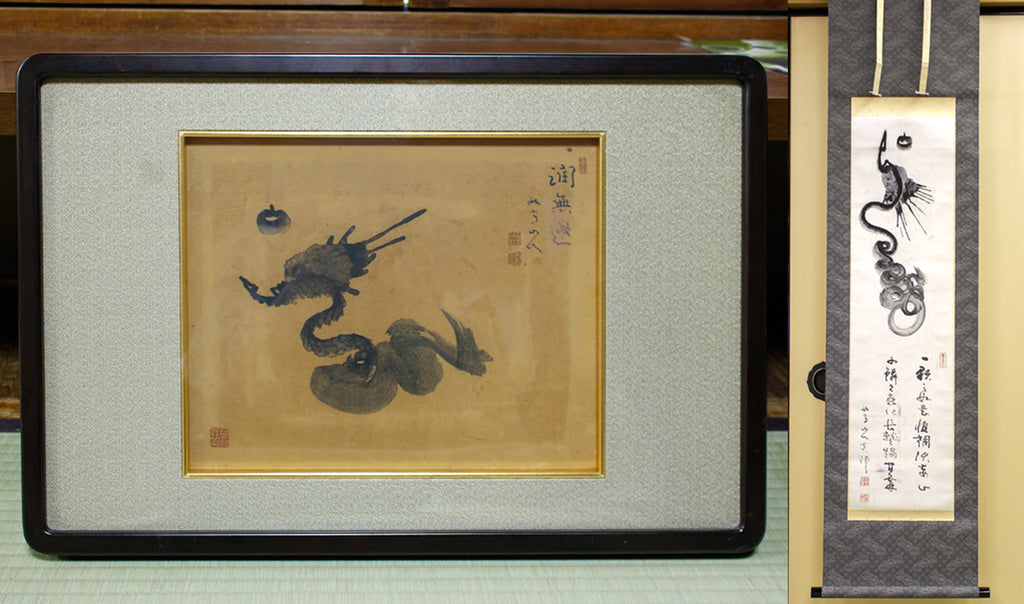 One-stroke dragon drawn at Toji-ji Temple about 80 years ago
As the name suggests, it is said to "connect people," "ensure continuous development and financial fortune," and "ensure continuous good relationships and growth." Since the Edo period, it has been cherished as a charm for good luck and fortune due to the blessings and protection it bestows.
Furthermore, the "nyoi-hoju" (wish-fulfilling jewel) held by the dragon is said to grant people's wishes and bring happiness and good health.
Japan itself is said to resemble the shape of a dragon, and since ancient times, dragons have been enshrined as deities in Shinto shrines and Buddhist temples.
The [Ascending Dragon] of the one-stroke dragon amulet is drawn with utmost sincerity for the fulfillment of great wishes. The [Guardian Dragon] is drawn with utmost sincerity for prayer for safety and protection.
When Keisuke Tejima, the artist of this amulet, visited Toji-ji Temple, he was deeply impressed by encountering a one-stroke dragon drawn about 80 years ago by the 105th head priest (Great Master Shinrui), which led to his connection with Toji-ji Temple.
Kyoto One-Stroke Dragon Artist Keisuke Tejima
 His technique of depicting beautiful, delicate, and sometimes ferocious dragon gods with a single stroke is highly acclaimed not only in Japan but also overseas. He learned the spirit of the Japanese way through 14 years of "Karate-do" from the age of 6, and has been fascinated by dragons since childhood, continuously drawing dragon paintings. He encountered the "one-stroke dragon" tradition passed down from ancient times, was impressed by its technique and history, and self-taught the skill. In his first year as an artist, he successfully held his first solo exhibition in Ginza, and then went global. With the belief of "bringing Japanese tradition to the world!", he held exhibitions and performances at 13 venues in Los Angeles, New York, Washington, and Florida. While preserving the tradition of one-stroke dragons that has continued since the Edo period, he pursues dragons with the spirit of "Shu-Ha-Ri" (to obey, to detach, to transcend).
Keisuke Tejima Media Appearances
| Japan | June 2022 - Film | "The Way of the Househusband: The Cinema" - Title back artwork production and appearance |
| Broadcast on Saturday, December 18, 2021 | Kansai TV "Footmap" appearance | |
| April 2021 - (12 episodes) Broadcast | TV Tokyo series "Drama Holic! / DIVE!!" - Artwork featured in the drama | |
| Broadcast on Monday, March 15, 2021 | Live drawing performance at the official stage greeting event for Disney's "Raya and the Last Dragon" | |
| Broadcast on Sunday, November 22, 2020 | TV Asahi "Nani Kore Chin Hyakkei" appearance | |
| Broadcast on Friday, November 13, 2020 | Yomiuri TV "Osaka Honwaka TV" appearance | |
| Broadcast on Friday, March 13, 2020 | Fuji TV "Mezamashi TV" [Kirabito] appearance | |
| Broadcast on Sunday, March 3, 2019 | AbemaTV 7.2 New Another Window #12 [1st All Japan Buzz Award] appearance | |
| Overseas | Broadcast on Thursday, April 19, 2018 | NHK WORLD channel NEWS ROOM TOKYO appearance |
| July 2018 - | Video featured on National Geographic |
 During the "Duterte Kitchen" one-stroke dragon charity auction in the Philippines, all of the approximately 10 million yen raised was donated to street children. From that connection, a live drawing demonstration and presentation of a one-stroke dragon was made to Manny Pacquiao at the Philippine Parliament building.
 For [Kyoto One-Stroke Dragon Ourindo Atelier & Gallery], click here
Japanese Dragons and Omamori

Japan is said to resemble the shape of a dragon, and since ancient times, it has been considered a mysterious country where dragons dwell .
Furthermore, since the Jomon and Yayoi periods, it has been worshipped as a water deity that brings the rain necessary for rice, which is the heart of the Japanese people .
Shinto shrines enshrine rice, and the straw, which is the husk of rice, is infinitely tied to create shimenawa (sacred ropes) and carefully dedicated. In line with this, there are always dragons in shrines . This represents an abundant harvest, as dragons are water deities that bring the life-giving rain essential for rice.
Another important element for rice is lightning, which purifies the atmosphere . The kanji for "lightning" (雷) combines "rain" (雨) and "field" (田), indicating its deep connection to rice fields.
A stronger form of lightning is called "inazuma" (稲妻), which is written as "rice" (稲) and "wife" (妻), and has been considered an indispensable and precious element for rice since ancient times.
The "lightning" and "inazuma" that occur during the dragon's descent bring beneficial rain for rice and are said to not only purify but also instantly reduce the oxidation in the air with electricity from the heavens, thereby purifying it.
Rice receives heavenly energy from this. In fact, it is said that a summer with a lot of lightning leads to a bountiful harvest, which is why. The "dragon" that travels across time and space brings this important "lightning" and "inazuma."
This is why Tejima's one-stroke dragon paintings often depict lightning and splashes of water .
Furthermore, the kanji for "harmony" or "Japan" (和) combines "rice plant radical" (禾) and "mouth" (口), representing a people who eat rice. Japan was also called "ZIPANG, the land of gold" because of the color of rice ears. The skin color of people of Asian descent is also said to be the color of rice. Rice is the soul, DNA, and life of the Japanese people . Therefore, dragons, which nurture rice—the root of the Japanese people—exist deeply in their hearts as lucky charms , and the dragon god resides in the hearts of the Japanese people .

What is an Omamori?
Since ancient times, people have believed that by keeping objects imbued with the power of the gods close to them, they could protect themselves from disasters and dangers . This belief eventually transformed into omamori, and various amulets began to be given out at shrines and temples .In Japan, omamori are considered manifestations of gods and Buddhas.
| Regarding the customs and origins (including historical connections) mentioned in the above text, numerous theories and alternative explanations exist. Within this context, we provide the content supervised by our secretariat. We humbly ask for your understanding should there be any differences in meaning or interpretation. |