
What is Kyoto Ichihitsuryu?

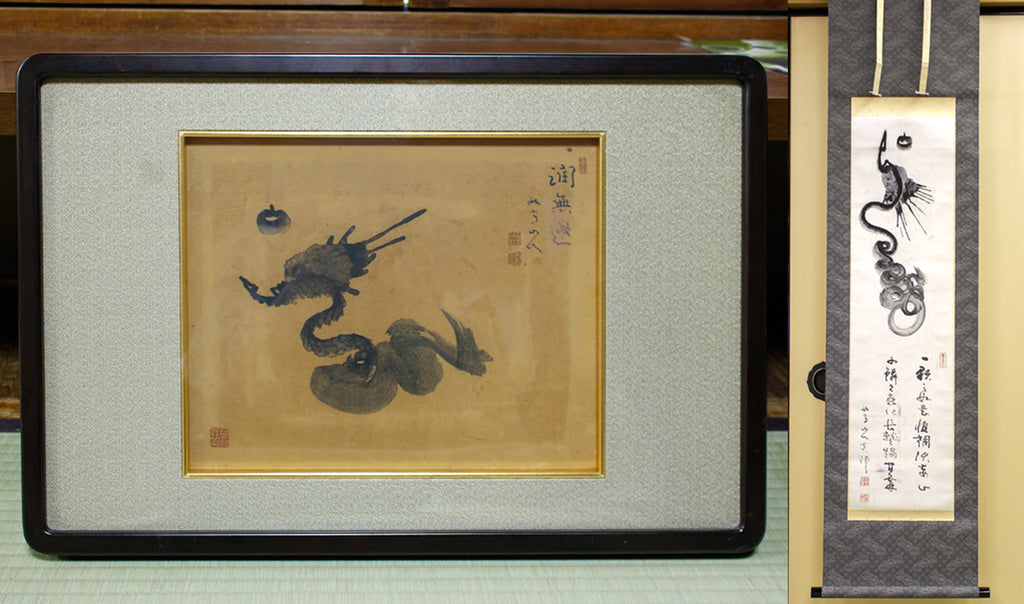 One-Stroke Dragon drawn about 80 years ago at Tojiji Temple
As the name suggests, it is believed to "connect people", bring "continuous development and financial fortune", and "continuous good relationships and growth". Since the Edo period, it has been cherished as a lucky charm and amulet for good fortune and divine protection.
The "Nyoi Hoshu" (Cintamani) held by the dragon is said to grant people's wishes and bring happiness and good health.
It is said that the Japanese archipelago itself is shaped like a dragon, and from ancient times, dragons have been worshipped as gods in shrines and temples.
The [Ascending Dragon] in the one-stroke dragon amulet is for prayer for the fulfillment of a great wish . The [Guardian Dragon] is drawn with all our heart and soul for prayer for safety and protection .
When Keisuke Teshima, the artist of these amulets, visited Tojiji Temple, he was deeply moved by his encounter with a one-stroke dragon drawn about 80 years ago by the 105th head priest (Great Monk Shinrui), which led to his connection with Tojiji Temple.
Japanese Dragons and Amulets

The shape of the Japanese archipelago is said to be that of a dragon, and from ancient times, Japan has been considered a mystical land where dragons reside .
Since the Jomon and Yayoi periods, it has also been worshipped as a water deity that brings the rain necessary for rice, which is the heart of the Japanese people .
Shrines enshrine rice, and the straw from rice husks is endlessly tied into shimenawa (sacred ropes) and reverently offered. In conjunction with this, there are always dragons in shrines . This represents abundant harvests, as the dragon is a water deity that brings the blessed rain essential for rice.
Another important element for rice is "thunder," which purifies the atmosphere . The character for "thunder" (雷) combines "rain" (雨) and "field" (田), indicating its deep connection to rice paddies.
A stronger form of "thunder" is called "inazuma" (稲妻), written as "rice" (稲) and "wife" (妻), and has been considered an indispensable and irreplaceable element for rice since ancient times.
The "thunder" and "lightning" that occur during the dragon's descent bring blessed rain for rice , and it is said that in addition to purification, the electricity from the heavens rapidly reduces the oxidation in the air, thereby purifying it.
Rice then receives this energy from heaven. Indeed, it is said that a summer with a lot of thunder leads to a bountiful harvest. It is the "dragon" that transcends time and space to bring this important "thunder" and "lightning."
This is why Teshima's one-stroke dragon paintings often depict lightning and water splashes .
Furthermore, the character "wa" (和) which represents Japan, is written with "rice" (イネへん) and "mouth" (口), representing a people who eat rice. The country being called ZIPANG, the land of gold, also referred to the color of rice ears. The skin color of East Asians is also said to be the color of rice. Rice is the 【soul of the Japanese people】, their DNA, and their life. Therefore, the dragon, which cultivates rice—the root of the Japanese people—exists deeply in their hearts as a lucky charm , and the Dragon God resides in the hearts of the Japanese people .

What is an Amulet?
From ancient times, people have believed that by keeping items imbued with divine power close to them, they could protect themselves from disasters and dangers . This gradually evolved into amulets, and various amulets came to be bestowed at shrines and temples.In Japan, amulets are considered embodiments of gods and buddhas.
| Regarding the customs and origins (including anecdotes) mentioned in the text above, there are numerous theories and alternative views. We have provided the content supervised by our office. We humbly ask for your understanding if there are any differences in meaning or interpretation. |